A. INTRODUCTION
The most common causes of Industrial Accidents are due to falls from a height. This may be due to improper quality so scaffolding, mixing of scaffold components of different manufacturers, different type of materials having different dimensions and tolerances, use of poor quality ladders, non use/ improper use of personal protective equipments (PPE) such as safety belts and hand gloves.
These procedures give outlines and details of safe work practices while working over water in Marine Offshorae Areas, Where scaffolding persona are exposed to the Possibility of failing into the water, where the work location is either underneath or over the side of the structure.
B. SCOPE
This procedure is applicable to all jobs done at heights and at offshore structures and pipelines etc, where permanent platforms/ railing are not provided and where Marine Offshore Hanging over water Scaffolding and ladders shall be used. This procedure contains the basic requirements of:-
- Work control
- Inspection
- Pre-Job training
- Tool box talks (Briefing Process)
- Safe work Practice and controls
During the erection, use, maintenance, disassembly or marine offshore Hanging Over Water Scaffolding at work site, Scaffolding Rating and Type requirements shall be best selected with consultation clearance and approval of the Client’s Engineer-in- Charge to suit the planned job activities and site conditions. The actual job shall start after obtaining the necessary clearance andwork permit from the Engineer-in- charge or his authorized representative.
C. OBJECTIVE
The objective of this procedure is to execute the job of Marine Offshore Over Water Hangin Scaffolding Erection, Use maintenance and Dismantling in a planned manner to achieve a safe and efficient methodology.
D. RESPONSIBILITIES OF CONTRACTORS QUALIFIED PERSONS.
Competent Persons: Competent persons authorized by the client shall be capable of identifying existing and predictable hazards in the surroundings or working conditions and shall have the authority to take prompt action to eliminate them. Contractor’s Scaffolding Engineers and upervisors shall perform the following activities with consultant and consent of the client’s Engineer-in- charge or his authorized representatives at all stages of work:
- Preliminary inspection of areas where the scaffoldings are to be erected and to plan the type and rating of scaffoldings which shall be required suiting to specific job requirements and site conditions.
- Inspection of material of scaffoldings to be used to each tier shall remain with each individual tier.
- Continuous supervision of the scaffolding’s erection, use, dismantling by experienced trained and also scaffolders under
- To obtain from the client or its authorized representatives:-
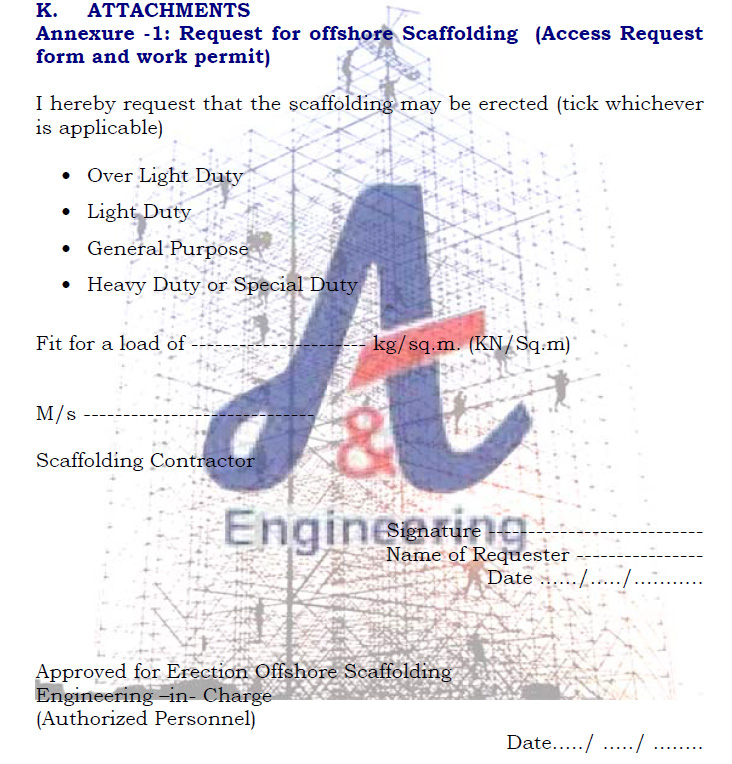
- Access Request Sheet (ARS)
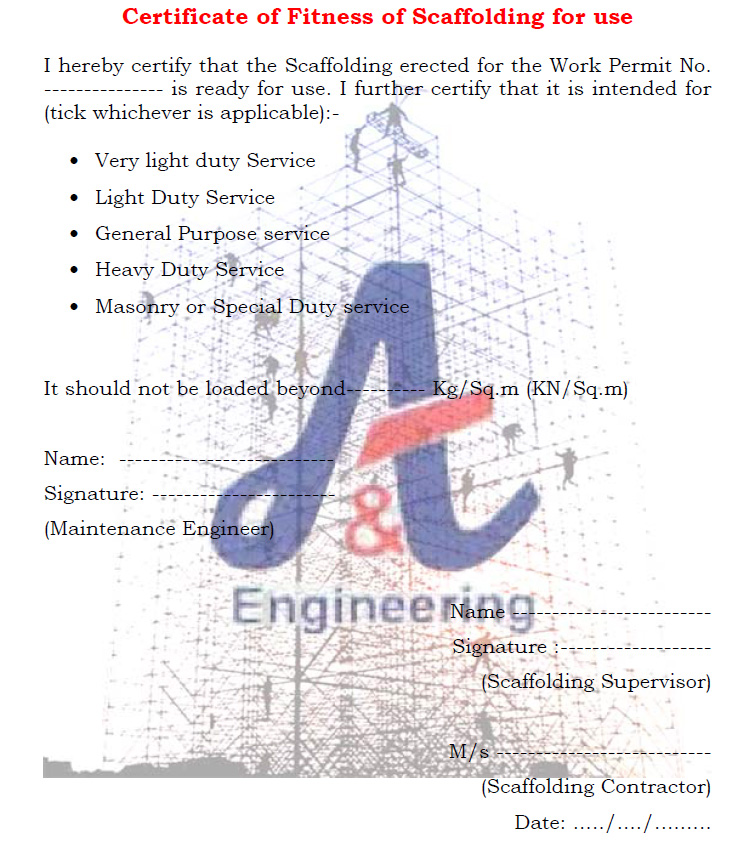
- Certificate for Scaffold is erected as per code and approved for fit for use
- Work permit.
To do joint inspection with the client’s representative to ensure that Safety requirements are met at all stages of work and periodic inspections of the erected Scaffoldings if these are to be sued for a prolonged period of time.
E. REFERENCES
The job shall be executed conforming to National and international Code of Safe Work Practices for Marine Offshore Over water handing Scaffolds as per the requirements of the client.
F. SCAFFOLDING LOAD BEARING
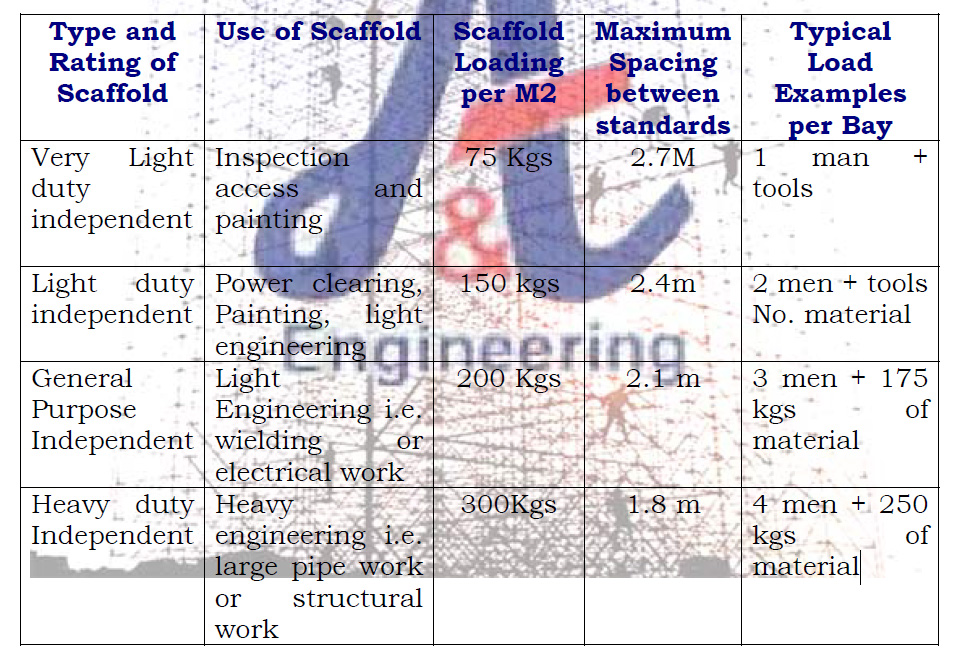
Scaffolds are classified according to their intended use and working loads permitted on scaffolds shall follow the guidelines given in the table below:-
G SPECIFICATIONS OF SCAFFOLDS
- Scaffolding shall conform to IS 4014 (for Steel Tubular) or equivalent B.S. Standard for all fasteners.
- All elevated Structures/ working platforms shall be guarded on all sides by guardrails or by other suitable arrangements.
- Guardrails shall be provided consisting of Top rail at a height of minimum1.10 meters and maximum 1.15 meters. Mid rails at a height of not more than 690 Mm above the top of the toe board shall be at least 200 mm height above decking.
- Scaffold materials shall have a factor of Safely 4:1 to the dead weight plus intended weight of men and material on platforms. The steel wire ropes used shall have a factor of Safety 6:1.
- If the scaffolding is erected for more than one tier, the load sharing of each tier shall remain with each individual tier.
- All fasteners shall be cleaned and greased once every 15 days.
- An escape route shall be provided at every 30 meters.
- All tool and tackles shall be specified for scaffolding erection and dismantling.
- Arrangements shall be made for a standby boat with a Life guard (Driver), Fist – Aid Kit and an emergency vehicle with driver.
- Scaffold Boards shall be stored above ground level and shall be stacked not more than 05 boards in height.
- Bracings shall be installed progressively starting from the base plate level with scaffolding to ensure rigidity. Only lead bearing fittings shall be used for installation of braces.
H. Ladders
- Ladders of suitable quality for offshore use and in good conditions shall be used.
- The foot of the ladder shall be supported on a firm and level surface. The ladders shall be fitted with non- slip feet.
- All ladders shall be inspected and colour code shall be done for “Fit for use” before putting ladders into use.
- Rungs spacing of ladders shall be not more than 30 cms.
- Ladders shall be placed at approximately 75 degree to the floor level. Example: 1 meter out of every 4 meter height.
- Contaminated ladders shall be taken out of service and cleaned.
- Ladders shall be positioned so that the stepping off rung is in level ith the platform against which it rests. A ladder shall extend to a height at least 1.05 meters above the landing space.
- Ladders shall be used with clean footwear, free from mud, oil grease and the user shall face the ladder while ascending and descending. Always three point contracts shall be maintained to avoid a fall from the ladder.
- Ladders shall not be placed near live electrical wires or operational piping where safety hazards many occur.
- Top of the ladders shall be fixed to a stable support and tied securely with a strong rope or by other tie fittings.
- Ladders more than 4 meters in height shall be braced at Intermediate points to prevent sagging.
- Strength, Rigidity (must not sag, whip or sway too much), Durability, Light and Portable.
I. Control and hand over Procedures
- Scaffolding control and hand over procedures shall be given as given below:-
- The requirement and approval if the Marine Offshore Scaffolding work Permit and Access Request shall be obtained from a competent person authorized by the Client.
- Material Shall be collected from the Engineer’s stores mobilized at the site.
- Scaffolding shall be erected by complying with the conditions specified below and all other requirements of the job.
- Scaffolding job of Erection, use and dismantling shall be done in the supervision of the company’s supervisor.
- Adequate PPE shall be provided at the site to all crew members working one the scaffolding job.
- Life vest.
- Safety harness
- Safety helmet.
- Safety boots with steel toe caps.
- Hand gloves.
- Safety goggles.
- Standby boat with diver, lifebuoy and emergency vehicle with driver shall be available at he site. The response time of the standing boat shall be within 10 minutes.
- First –Aid box shall be kept at the site.
- Scaffolding Engineers and supervisors shall do “daily tool Box talk” with scaffolders prior to the start of the job.
- All personnel engaged in Erection, Use and dismantling which require working over water shall were flotation devices, fall arrest or prevention devices.
- Team leader/ In charge shall be present at all stages of the job and shall be in communication or visuals contract with scaffolders.
- Joint inspection of erected Scaffolding shall be carried out with the Client’s Authorized representative and certificate of “Fit for use” shall be obtained from a competent person.
- If the scaffolding is erected for a longer duration of time, the scaffolds shall be inspected every 7 days or after any permitted modification on the scaffold or bad weather.
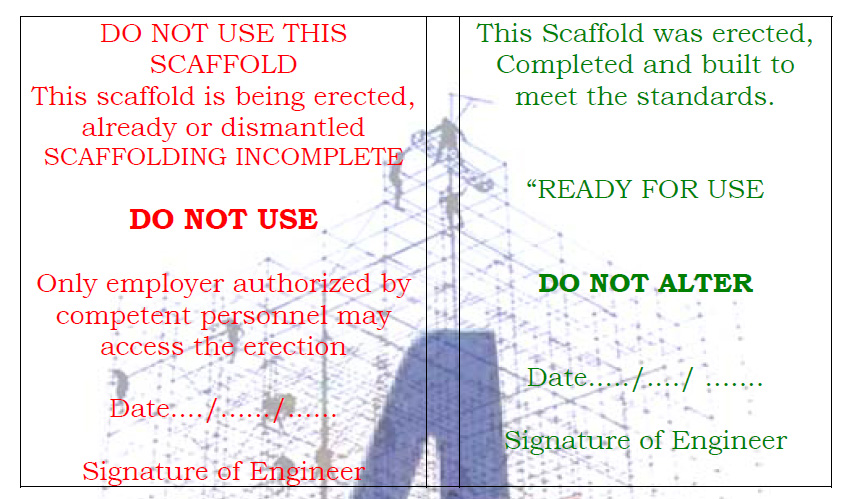
- Scaffolding tags near the access points of the Scaffold shall be attached at all times and permanent markers shall be used to complete the required formalities on the tags.
Work shall not be permitted during height winds if wind velocity is 30 miles/ hour (30 Mph) gusts or higher.
Scaffold distance between an insulated 220 vilt lines shall be at least 3 feet.
J. TRAINING
Supervisors and Scaffolders are trained from time to timeby a trainer NV Q Level -2 or level -3 qualified in Offshore scaffolding. The following topics shall be at least shall be covered during training. It shall be ensured that scaffolders are provided technical and practical training required for the job.
Types of scaffolding used for offshore jobs.
- Standards of material used for a hanging scaffold.
- Specification and requirement of a hanging scaffold
- Standard tools used for the erection of a Scaffold.
- Installation of ladders and escape route provision.
- Right way of fixing the clamps, planks and GI tubes.
- Distribution of the load and safe working load of scaffold per square meter.
- On field practical training on scaffold erection.
HANGING SCAFFOLDING
- Beam clamps are tested.
- Standards are plumb.
- Ledgers and Transom are level.
- Ledgers and Transom are correctly spread.
- Joints are staggered both, vertically and horizontally in standards and ledgers.
- There are sufficient braces.
- The boards are sound and free from defects.
- The boards are properly supported.
- Guardrails and Toe boards are in place.
- Ledgers are sound and correctly fixed.
- The correct fittings (Couplers) are used and they are properly secured.